
Comprehensive Rotator Cuff Tear Evaluations in Fayetteville, NC
Rotator cuff tear evaluations at Cape Fear Physical Medicine help identify the cause and severity of shoulder tendon injuries. Dr. Meisha K. Abbasinejad and the team perform thorough assessments to evaluate pain, weakness, and limited mobility. Each evaluation combines physical examination with advanced imaging when needed to provide a complete diagnosis. These assessments guide personalized treatment plans to restore shoulder function and reduce discomfort. For more information, contact us or schedule an appointment online. We are conveniently located at 1540 Purdue Dr, Ste. 200, in Fayetteville, NC 28303.
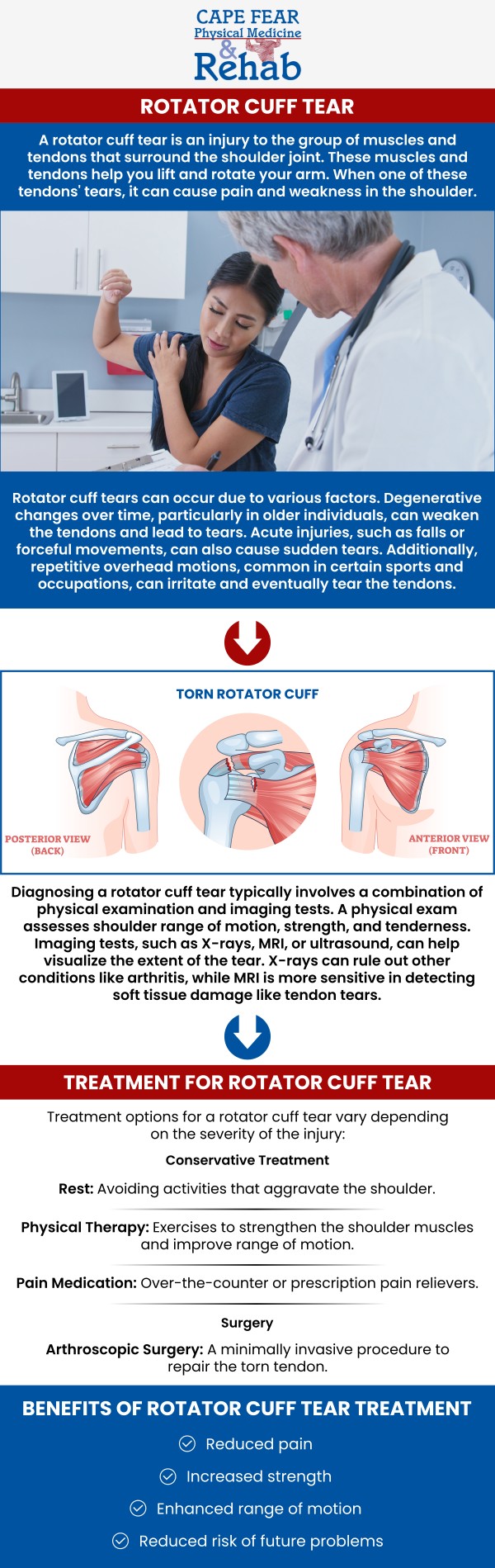
Table of Contents:
What is a rotator cuff tear, and how is it diagnosed?
How do I know if I have a rotator cuff tear?
What are the common symptoms of a rotator cuff tear?
What can I expect during a rotator cuff tear evaluation?
How does Dr. Meisha K. Abbasinejad approach diagnosing rotator cuff injuries in Fayetteville, NC?
A rotator cuff tear occurs when one or more of the four tendons that stabilize the shoulder joint become damaged, frayed, or completely torn. This condition can develop gradually due to repetitive overhead motions, aging, or acute trauma, such as a fall or lifting a heavy object. Tears can vary in severity, ranging from partial tears, which affect only a portion of the tendon, to full-thickness tears that separate the tendon entirely from the bone. The resulting loss of tendon integrity can limit shoulder strength, range of motion, and function, affecting daily activities such as lifting, reaching, or even simple movements like combing hair.
Diagnosing a rotator cuff tear begins with a comprehensive physical exam to assess shoulder strength, flexibility, and pain patterns. At Cape Fear Physical Medicine and Rehab in Fayetteville, NC, Dr. Meisha K. Abbasinejad and the team offer rotator cuff tear evaluations that include specialized maneuvers to determine which tendon may be injured. Imaging studies are often incorporated to confirm the diagnosis and assess the size and extent of the tear. These evaluations provide a clear understanding of the injury, helping guide treatment decisions.
Timely diagnosis is essential to prevent further damage, reduce pain, and preserve shoulder function. Early intervention, guided by expert clinicians like Dr. Abbasinejad, can improve recovery outcomes and minimize the need for surgical repair in some cases. By offering thorough rotator cuff tear evaluations, Cape Fear Physical Medicine and Rehab ensures patients receive accurate diagnoses, personalized care plans, and access to both conservative and advanced treatment options tailored to their specific injury and lifestyle.
Recognizing a rotator cuff tear often begins with noticing persistent shoulder pain or weakness, especially when lifting or rotating the arm. Pain may be felt at rest, worsen at night, or interfere with sleep, particularly if lying on the affected side. Patients may also experience a clicking or popping sensation during shoulder movement, limited range of motion, or difficulty performing overhead tasks. Weakness when trying to lift objects or raise the arm to the side can indicate tendon involvement.
At Cape Fear Physical Medicine and Rehab in Fayetteville, NC, Dr. Meisha K. Abbasinejad and her team provide expert evaluations for rotator cuff tears. Individuals who have experienced repetitive shoulder strain, minor injuries, or sudden trauma are encouraged to schedule an assessment.
Early recognition and evaluation are critical because untreated tears can worsen over time, potentially leading to chronic pain, limited mobility, or compensatory injuries in surrounding muscles. Dr. Abbasinejad emphasizes individualized assessments that consider your medical history, activity level, and lifestyle to guide appropriate treatment. By offering dedicated rotator cuff tear evaluations, Cape Fear Physical Medicine and Rehab helps patients clearly understand their condition and determine the most effective management strategy.
Rotator cuff tears commonly present with a combination of pain, weakness, and reduced shoulder mobility. Pain is often concentrated on the outer shoulder and may radiate down the arm. Nighttime discomfort, particularly when lying on the affected side, is frequent, as is pain when performing overhead or behind-the-back motions. Weakness in lifting or rotating the arm can indicate that the tendon’s function is compromised. Additionally, some patients report a clicking, popping, or catching sensation during certain movements.
Other subtle symptoms may include difficulty performing everyday tasks such as combing hair, reaching for objects on shelves, or carrying groceries. Chronic tears can cause compensatory movements that stress surrounding muscles, leading to further discomfort or secondary injuries. At Cape Fear Physical Medicine and Rehab, rotator cuff tear evaluations offered by Dr. Meisha K. Abbasinejad and her team include thorough assessments to identify these symptoms and determine their severity.
A rotator cuff tear evaluation begins with a detailed review of your medical history and an assessment of your shoulder symptoms. Dr. Meisha K. Abbasinejad and her team will ask about the onset of pain, activities that aggravate it, prior injuries, and any limitations in daily function. The physical exam includes tests of shoulder strength, range of motion, and specific maneuvers designed to isolate the affected tendon.
Imaging studies may be ordered to confirm the diagnosis. Ultrasound or MRI provides a clear view of tendon integrity, tear size, and surrounding structures, complementing the findings from the physical exam. During the evaluation, patients are guided through gentle movements to safely assess functional limitations without causing further damage. Cape Fear Physical Medicine and Rehab emphasizes comfort, safety, and thoroughness throughout the process.
After the evaluation, Dr. Abbasinejad reviews the results in detail, explaining the type and severity of the tear. The clinic offers rotator cuff tear evaluations that help determine whether conservative measures and activity modification are appropriate or invasive treatment is needed. Patients leave with a clear understanding of their diagnosis and guidance on steps to reduce pain and restore function.
Dr. Meisha K. Abbasinejad takes a comprehensive, patient-centered approach when diagnosing rotator cuff injuries at Cape Fear Physical Medicine and Rehab. The process begins with a detailed discussion of your symptoms, activity level, and medical history. She emphasizes understanding how the shoulder injury affects daily function and long-term quality of life.
Physical examination techniques are tailored to isolate each tendon of the rotator cuff and identify areas of weakness, pain, or restricted motion. If needed, advanced imaging is incorporated to confirm the presence and extent of the tear. Dr. Abbasinejad and her team offer rotator cuff tear evaluations that combine clinical expertise with evidence-based diagnostic tools, ensuring accuracy and clarity.
After the evaluation, Dr. Abbasinejad reviews findings with patients in detail, explaining the type of tear and possible causes. This approach allows patients to make informed decisions about their care. By offering thorough, personalized evaluations for rotator cuff tears, Cape Fear Physical Medicine and Rehab ensures patients in Fayetteville, NC receive guidance and a clear path to recovery. Contact us today for more information, or simply schedule an appointment online. We are conveniently located at 1540 Purdue Dr, Ste. 200, in Fayetteville, NC 28303. We serve patients from Fayetteville NC, Woodfield NC, Hope Mills NC, Fort Bragg NC, Eastover NC, and surrounding areas.

Check Out Our 5 Star Reviews


Additional Services You May Like
▸ Weight Loss & Wellness Program
▸ Botox for Migraine
▸ EMG Nerve Conduction Studies
▸ Epidural Steroid Injections
▸ Radiofrequency Ablation
▸ Rehabilitation Consultations
▸ Facet Injections
▸ Sacroiliac Joint Injections
▸ Joint Injections
▸ Genicular Nerve Blocks
▸ Prosthetic Evaluation/Management
▸ Adjuvant Therapy/Care
▸ Spasticity Management
▸ Stroke Treatment
▸ Multiple Sclerosis
▸ Spinal Cord Injury
▸ Traumatic Brain Injury
▸ Lifestyle Medicine
▸ Phentermine
▸ Qsymia
▸ Contrave
▸ Lipo Injection
▸ B12 Injections

Additional Services You May Like
▸ Weight Loss & Wellness Program
▸ Botox for Migraine
▸ EMG Nerve Conduction Studies
▸ Epidural Steroid Injections
▸ Radiofrequency Ablation
▸ Rehabilitation Consultations
▸ Facet Injections
▸ Sacroiliac Joint Injections
▸ Joint Injections
▸ Genicular Nerve Blocks
▸ Prosthetic Evaluation/Management
▸ Adjuvant Therapy/Care
▸ Spasticity Management
▸ Stroke Treatment
▸ Multiple Sclerosis
▸ Spinal Cord Injury
▸ Traumatic Brain Injury
▸ Lifestyle Medicine
▸ Phentermine
▸ Qsymia
▸ Contrave
▸ Lipo Injection
▸ B12 Injections


 Send Text
 How May I Help You?