

Botox for Migraine Treatment in Fayetteville, NC
At Cape Fear Physical Medicine and Rehab, Dr. Meisha K. Abbasinejad, MD, evaluates each patient’s headache frequency, migraine symptoms, treatment history, medications, and overall health before determining whether Botox may be appropriate. The treatment plan is individualized according to the patient’s chronic migraine pattern, with follow-up visits used to monitor headache days, symptom severity, daily function, treatment response, and possible side effects. Contact us today for more information, or schedule an appointment online! We are conveniently located at 1540 Purdue Dr, Ste. 200, in Fayetteville, NC 28303.
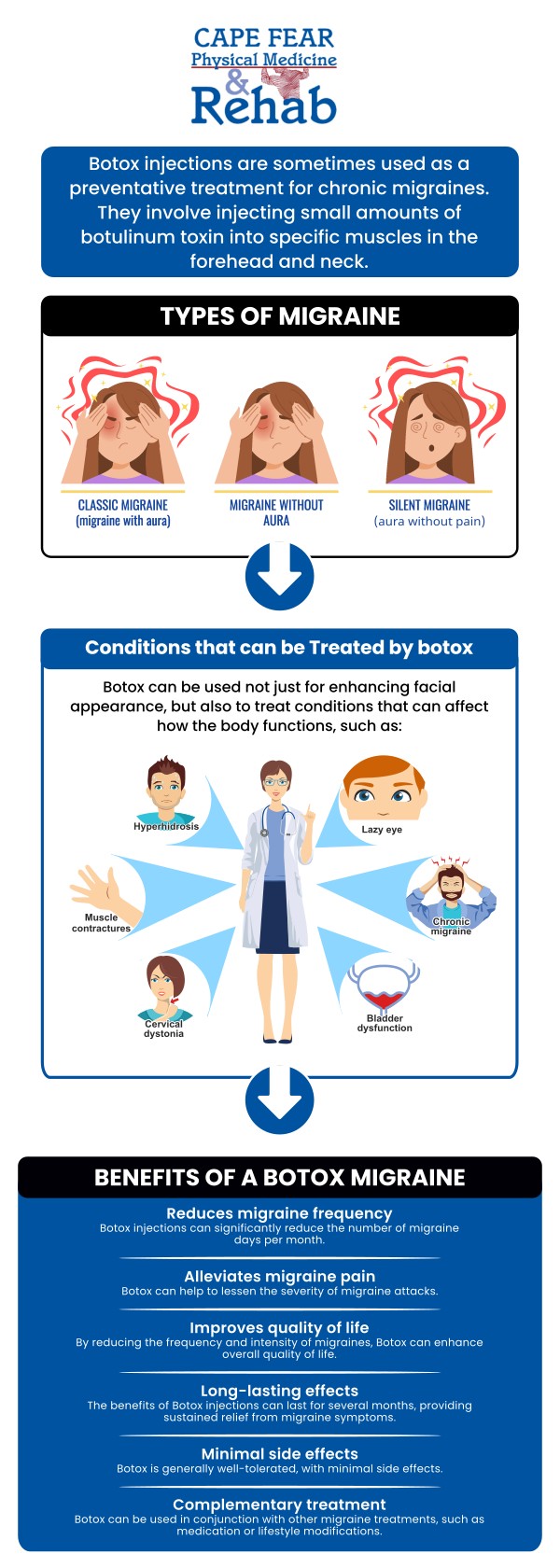
Table of Contents:
How can Botox help with migraines?
Where do they inject Botox for migraine?
How long does Botox for migraines last?
Who may be a good candidate for Botox for migraines?
What is the success rate of Botox for migraines?
Managing Chronic Migraines With Botox at Cape Fear Physical Medicine and Rehab
While you may be familiar with or have heard of Botox injections as a cosmetic treatment, they have significant medical uses, as well! Botox injections reduce chronic migraine frequency and severity. As such, if you are dealing with chronic migraines, our medical providers at Cape Fear Physical Medicine and Rehab would be happy to provide you with Botox treatment to help you find long-lasting relief from your migraine symptoms.
Botox is used as a preventive treatment for qualifying adults with chronic migraine. It is intended for individuals who experience headaches on 15 or more days per month, with headaches lasting four hours a day or longer. It is not designed to provide immediate relief from a migraine that has already started.
Botox works by interfering with the release of chemical signals involved in pain transmission. When administered at specific head and neck locations, it may help reduce how frequently chronic migraine headaches occur and lessen their effect on daily activities. Results vary, and repeated treatment sessions may be needed to evaluate an individual’s response.
At Cape Fear Physical Medicine and Rehab, our team reviews each patient’s migraine history, headache frequency, symptoms, previous treatments, medications, and overall health before recommending Botox. Ongoing follow-up helps evaluate changes in headache days, symptom severity, daily function, treatment response, and possible side effects.
Botox for chronic migraines is injected into specific muscles across the head and neck rather than directly into the area where a person feels pain. The standard treatment pattern generally includes multiple small injections placed at predetermined locations to help prevent migraine headaches.
Common injection areas include the:
• Forehead and area between the eyebrows
• Temples
• Back of the head
• Upper neck
• Upper shoulders
These locations correspond to seven head and neck muscle groups involved in the established chronic migraine injection protocol. The exact placement should be determined by a qualified medical professional based on the recommended treatment approach and the patient’s clinical evaluation.
At Cape Fear Physical Medicine and Rehab, patients are evaluated before Botox treatment to determine whether their headache pattern is consistent with chronic migraine and whether the procedure may be appropriate. The treatment plan, injection locations, possible side effects, and follow-up schedule are discussed before the procedure.
The effects of Botox for chronic migraine commonly last for approximately 12 weeks, although the duration can vary from person to person. The FDA-recommended retreatment schedule is every 12 weeks because the preventive effect may gradually decrease as the next treatment date approaches.
Some patients notice improvement within the first several weeks, while others may need two or three treatment cycles before experiencing a clearer response. Treatment is preventive rather than an immediate treatment for a migraine already in progress, and maintaining the recommended schedule may help provide more consistent symptom control.
At Cape Fear Physical Medicine and Rehab, follow-up visits help our team assess how long each treatment remains effective and whether headache frequency, severity, or daily function has changed. The timing of future sessions is determined according to the recommended schedule, the patient’s response, and their overall treatment plan.
Adults may be good candidates for Botox for migraines when they:
• Experience headaches on 15 or more days each month
• Have headaches lasting four hours a day or longer
• Have been diagnosed with chronic migraine
• Need preventive treatment rather than immediate migraine relief
• Continue to experience frequent migraines despite previous treatments
• Have symptoms that interfere with work, sleep, or daily activities
• Do not have medical conditions that make Botox inappropriate
At Cape Fear Physical Medicine and Rehab, our team reviews headache frequency, migraine duration, symptoms, treatment history, medications, and overall health before determining whether Botox may be appropriate.
There is no single success rate for Botox because treatment response differs among patients and may be measured by fewer headache days, reduced migraine severity, or improved daily function. In FDA-reviewed clinical trials, patients receiving Botox experienced an average reduction of approximately 7.8 to 9.2 headache days per 28-day period after two treatment cycles.
Treatment success may include:
• Fewer monthly headache or migraine days
• Shorter or less severe migraine episodes
• Reduced disruption to work and daily activities
• Less reliance on acute migraine treatment
Research also found that about 49% of patients achieved at least a 50% reduction in headache days after the first treatment cycle, while some patients responded only after additional cycles. Results are not guaranteed, and several sessions may be needed before the overall response can be evaluated. At Cape Fear Physical Medicine and Rehab, our team reviews each patient’s headache frequency, migraine symptoms, previous treatments, and functional limitations before recommending Botox. Progress may be monitored using a headache diary that records headache days, symptom severity, duration, and changes in daily activities.
Dr. Meisha K. Abbasinejad, MD, evaluates each patient’s headache frequency, migraine history, symptom pattern, previous treatments, medications, and overall health before determining whether Botox may be appropriate. As a preventive option for qualifying adults with chronic migraine, Botox may help reduce the number of headache days and lessen the effect migraines have on work, sleep, and daily activities.
At Cape Fear Physical Medicine and Rehab, treatment is personalized according to each patient’s needs and response. Follow-up visits allow Dr. Abbasinejad to monitor headache frequency, symptom severity, treatment tolerance, and changes in daily function. The care plan may be adjusted over time to support consistent migraine management and realistic treatment goals. Contact us today for more information, or simply schedule an appointment online! We are conveniently located at 1540 Purdue Dr, Ste. 200, in Fayetteville, NC 28303. We serve patients from Fayetteville NC, Woodfield NC, Hope Mills NC, Fort Bragg NC, Eastover NC, and surrounding areas.

Check Out Our 5 Star Reviews


Additional Services You May Like
▸ Weight Loss & Wellness Program
▸ Botox for Migraine
▸ EMG Nerve Conduction Studies
▸ Epidural Steroid Injections
▸ Radiofrequency Ablation
▸ Rehabilitation Consultations
▸ Facet Injections
▸ Sacroiliac Joint Injections
▸ Joint Injections
▸ Genicular Nerve Blocks
▸ Prosthetic Evaluation/Management
▸ Adjuvant Therapy/Care
▸ Spasticity Management
▸ Stroke Treatment
▸ Multiple Sclerosis
▸ Spinal Cord Injury
▸ Traumatic Brain Injury
▸ Lifestyle Medicine
▸ Phentermine
▸ Qsymia
▸ Contrave
▸ Lipo Injection
▸ B12 Injections

Additional Services You May Like
▸ Weight Loss & Wellness Program
▸ Botox for Migraine
▸ EMG Nerve Conduction Studies
▸ Epidural Steroid Injections
▸ Radiofrequency Ablation
▸ Rehabilitation Consultations
▸ Facet Injections
▸ Sacroiliac Joint Injections
▸ Joint Injections
▸ Genicular Nerve Blocks
▸ Prosthetic Evaluation/Management
▸ Adjuvant Therapy/Care
▸ Spasticity Management
▸ Stroke Treatment
▸ Multiple Sclerosis
▸ Spinal Cord Injury
▸ Traumatic Brain Injury
▸ Lifestyle Medicine
▸ Phentermine
▸ Qsymia
▸ Contrave
▸ Lipo Injection
▸ B12 Injections


 Send Text
 How May I Help You?