
Who Offers Radiofrequency Ablation in Fayetteville, NC?
Radiofrequency ablation (RFA) is a highly effective treatment option for managing chronic pain, particularly in conditions like joint pain and nerve-related discomfort. At Cape Fear Physical Medicine and Rehab, we offer RFA services to provide long-lasting relief for our patients. This minimally invasive procedure uses targeted heat to disrupt pain signals, helping to reduce inflammation and improve mobility. Our professional team is committed to tailoring treatments to your unique needs, ensuring the best possible outcomes for your pain management journey. Contact us today for more information, or simply schedule an appointment online! We are conveniently located at 1540 Purdue Dr, Ste. 200, in Fayetteville, NC 28303.
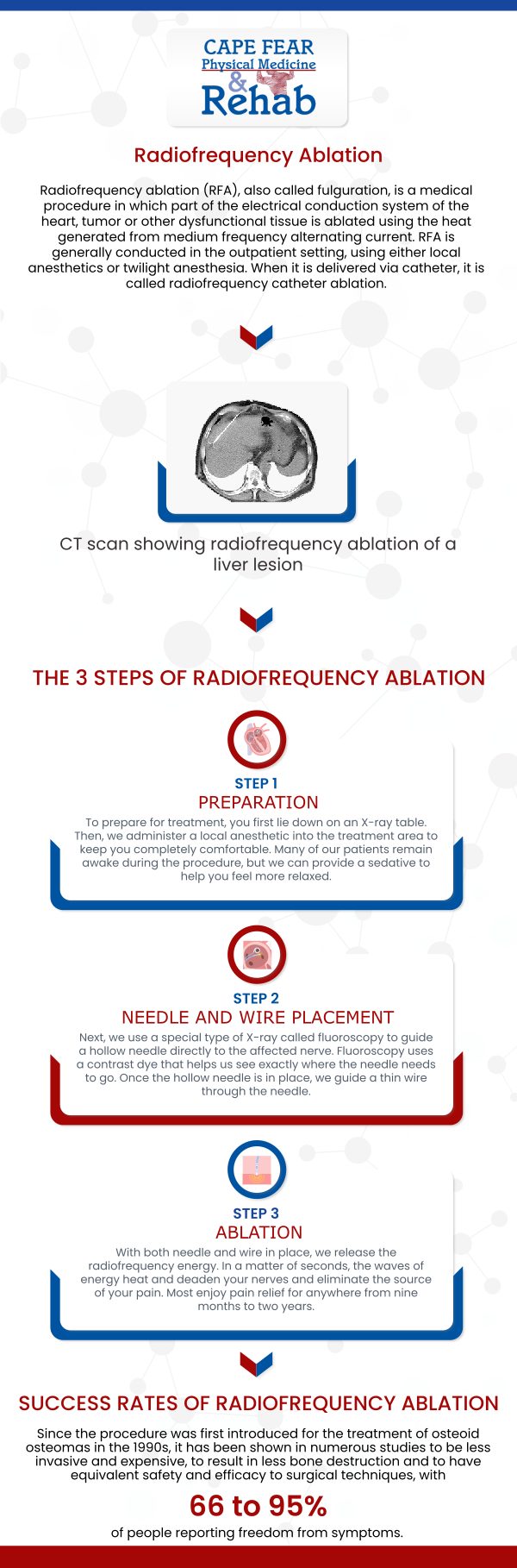
Table of Contents:
What is a radiofrequency ablation procedure?
How does radiofrequency ablation work?
Who is a candidate for radiofrequency ablation?
What are the benefits of radiofrequency ablation?
Is radiofrequency ablation painful?
How long does radiofrequency ablation pain relief last?
Is there downtime after radiofrequency ablation?
Why Choose Cape Fear Physical Medicine and Rehab for Radiofrequency Ablation in Fayetteville, NC?
If you have successfully received steroid injections or nerve blocks for pain relief in the past but are looking for a treatment that provides longer-lasting and more substantial pain relief, radiofrequency ablation could be an ideal option for you. At Cape Fear Physical Medicine and Rehab, our medical doctors and physician assistants would be pleased to provide this service to you.
A radiofrequency ablation procedure is a minimally invasive treatment used to manage certain types of chronic neck, back, and joint pain. It is also called radiofrequency neurotomy or rhizotomy. During the procedure, controlled radiofrequency energy produces heat near carefully selected nerves, reducing their ability to send pain signals to the brain.
The physician typically uses imaging guidance to position a specialized needle near the targeted nerve. Once placement is confirmed, radiofrequency energy creates a small, controlled lesion in the nerve tissue. The procedure does not treat every cause of pain, and relief may be temporary because the affected nerve can gradually regenerate over time.
Radiofrequency ablation may be considered for conditions such as:
• Arthritis of the spine, also known as spondylosis
• Facet joint pain
• Cervicogenic headaches
• Sacroiliac joint pain
• Sacroiliitis
• Sacroiliac joint dysfunction
A medical evaluation and, in many cases, a successful diagnostic nerve block are used to determine whether radiofrequency ablation may be appropriate.
Radiofrequency ablation works by using controlled radiofrequency energy to heat a small, carefully targeted area of nerve tissue. This reduces the nerve’s ability to transmit pain signals to the brain. It may be considered for certain types of chronic pain involving the neck, lower back, sacroiliac joints, or other painful joints when the source of discomfort has been appropriately identified.
During the procedure, a physician guides a specialized needle near the targeted nerve, typically with imaging assistance to confirm accurate placement. Radiofrequency energy then passes through the needle to create a small lesion on the nerve. Because nerves may gradually recover, pain relief is not necessarily permanent, and the duration and degree of improvement vary among patients.
At Cape Fear Physical Medicine and Rehab, we review each patient’s symptoms, diagnostic findings, prior treatments, and response to nerve blocks before determining whether radiofrequency ablation may be appropriate. We provide individualized guidance and follow-up focused on pain reduction, improved mobility, and better everyday function.
A candidate for radiofrequency ablation is typically someone with persistent, well-localized pain arising from specific nerves or joints, often involving the neck, lower back, sacroiliac region, hip, or knee. The procedure may be considered when pain has continued despite conservative measures such as activity modification, rehabilitation, or other non-surgical care.
Patients may also need to experience meaningful temporary relief from a diagnostic nerve block before radiofrequency ablation is recommended. This response helps the physician confirm that the targeted nerve is likely contributing to the pain. Eligibility also depends on the patient’s overall health, examination findings, medical history, current medications, and treatment goals.
At Cape Fear Physical Medicine and Rehab, board-certified physician Dr. Meisha K. Abbasinejad, MD, evaluates each patient’s pain pattern, diagnostic results, previous treatments, mobility limitations, and response to nerve blocks. We use this information to determine whether radiofrequency ablation may be an appropriate option for improving comfort and everyday function.
Radiofrequency ablation may provide targeted relief for certain types of chronic pain by using controlled heat to reduce the ability of selected nerves to transmit pain signals. It is commonly considered for appropriately diagnosed pain involving the back, neck, hips, knees, or specific joints when conservative treatments have not provided sufficient improvement.
Potential benefits may include:
• Reduced pain from carefully identified nerves
• Improved mobility and participation in daily activities
• A minimally invasive, outpatient procedure
• No need for a large surgical incision
• A relatively brief recovery period
• Relief that may continue for several months in some patients
• Greater comfort during exercise or rehabilitation
Results vary, and radiofrequency ablation does not improve every type of pain or provide permanent relief. At Cape Fear Physical Medicine and Rehab, our skilled team reviews each patient’s symptoms, diagnostic findings, previous treatments, and response to nerve blocks before determining whether the procedure may be appropriate. We provide individualized follow-up focused on pain relief, mobility, and everyday function
The treatment area is typically numbed before the procedure, although patients may feel pressure, warmth, or mild discomfort. Temporary soreness around the needle site may occur afterward and generally improves as the area heals.
The duration of relief varies from patient to patient. Some people experience limited or short-term improvement, while others may have reduced pain for several months before the treated nerves gradually recover.
Radiofrequency ablation is generally performed as an outpatient procedure, allowing patients to return home the same day. Mild soreness may occur, and patients should follow their physician’s instructions regarding activity and recovery.
Cape Fear Physical Medicine and Rehab provides personalized radiofrequency ablation care for patients with chronic pain that may be linked to specific nerves or joints. Led by board-certified physician Dr. Meisha K. Abbasinejad, MD, we review each patient’s symptoms, medical history, previous treatments, diagnostic findings, and functional limitations before determining whether the procedure may be appropriate.
We also explain what patients can expect before, during, and after radiofrequency ablation and provide follow-up to assess pain relief, mobility, and daily function. We focus on careful evaluation, clear communication, and individualized medical guidance designed to help patients pursue longer-lasting pain relief and improved quality of life. Contact us today or schedule an appointment to learn more about how RFA can offer lasting pain relief and get back to enjoying your everyday activities. We are conveniently located at 1540 Purdue Dr, Ste. 200, in Fayetteville, NC 28303. We serve patients from Fayetteville NC, Woodfield NC, Hope Mills NC, Fort Bragg NC, Eastover NC, and surrounding areas.

Check Out Our 5 Star Reviews


Additional Services You May Like
▸ Weight Loss & Wellness Program
▸ Botox for Migraine
▸ EMG Nerve Conduction Studies
▸ Epidural Steroid Injections
▸ Radiofrequency Ablation
▸ Rehabilitation Consultations
▸ Facet Injections
▸ Sacroiliac Joint Injections
▸ Joint Injections
▸ Genicular Nerve Blocks
▸ Prosthetic Evaluation/Management
▸ Adjuvant Therapy/Care
▸ Spasticity Management
▸ Stroke Treatment
▸ Multiple Sclerosis
▸ Spinal Cord Injury
▸ Traumatic Brain Injury
▸ Lifestyle Medicine
▸ Phentermine
▸ Qsymia
▸ Contrave
▸ Lipo Injection
▸ B12 Injections

Additional Services You May Like
▸ Weight Loss & Wellness Program
▸ Botox for Migraine
▸ EMG Nerve Conduction Studies
▸ Epidural Steroid Injections
▸ Radiofrequency Ablation
▸ Rehabilitation Consultations
▸ Facet Injections
▸ Sacroiliac Joint Injections
▸ Joint Injections
▸ Genicular Nerve Blocks
▸ Prosthetic Evaluation/Management
▸ Adjuvant Therapy/Care
▸ Spasticity Management
▸ Stroke Treatment
▸ Multiple Sclerosis
▸ Spinal Cord Injury
▸ Traumatic Brain Injury
▸ Lifestyle Medicine
▸ Phentermine
▸ Qsymia
▸ Contrave
▸ Lipo Injection
▸ B12 Injections


 Send Text
 How May I Help You?