

Where to Find Sacroiliac Joint Injections in Fayetteville, NC?
At Cape Fear Physical Medicine and Rehab, board-certified physician Dr. Meisha K. Abbasinejad, MD, evaluates patients experiencing lower back, buttock, or pelvic-area pain that may involve the sacroiliac joint. We review symptoms, medical history, physical findings, and prior treatments before determining whether a sacroiliac joint injection may be appropriate. Patients in Fayetteville, NC, receive personalized, physician-guided care focused on identifying the source of discomfort, improving mobility, and supporting better daily function. For more information, contact us or schedule an appointment online. We are conveniently located at 1540 Purdue Dr, Ste. 200, in Fayetteville, NC 28303.
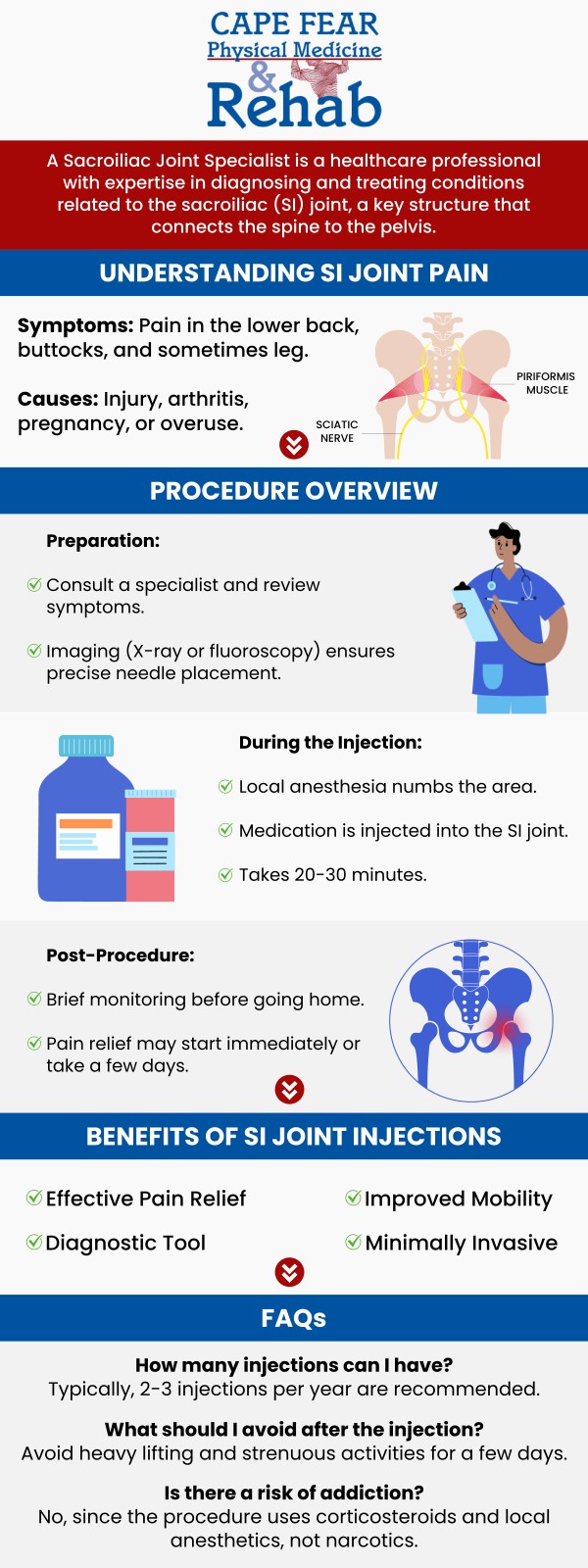
Table of Contents:
What are sacroiliac joint injections?
What activities can aggravate sacroiliac joint pain?
What happens during a sacroiliac joint injection procedure?
How often can you get sacroiliac joint injections?
Who may be a good candidate for sacroiliac joint injections?
How soon can relief begin after a sacroiliac joint injection?
What should patients expect after a sacroiliac joint injection?
How Does Dr. Meisha K. Abbasinejad, MD, Personalize Sacroiliac Joint Injection Care at Cape Fear Physical Medicine and Rehab?
Made up of the sacrum and the ilium, the sacroiliac joints connect the pelvis and the lower spine. There are two sacroiliac joints, one on each side of the lower back. Dysfunction in either of these joints can cause leg pain, as well as pain in the lower back. Due to the similarity of their symptoms, sacroiliac leg pain can be hard to differentiate from sciatica. Because the sacroiliac joints are responsible for 15% to 30% of cases of lower back pain, it is essential to receive a professional diagnosis when experiencing lower back or leg pain.
Sacroiliac joint injections are minimally invasive procedures used to evaluate or treat pain arising from the sacroiliac joints, which connect the lower spine to the pelvis. Pain involving these joints may be felt in the lower back, buttocks, hips, or upper legs and can worsen with prolonged sitting, standing, walking, or certain movements.
During the procedure, a physician guides a needle into the sacroiliac joint, commonly using an imaging method for accurate placement. A diagnostic injection typically contains a local anesthetic to help determine whether the joint is the source of pain. A therapeutic injection may include an anesthetic and an anti-inflammatory medication intended to reduce pain and inflammation.
At Cape Fear Physical Medicine and Rehab, we carefully review each patient’s pain pattern, examination findings, movement difficulties, and response to prior care. Using this information, we determine whether a sacroiliac joint injection may be suitable and provide individualized support aimed at reducing discomfort and improving daily mobility.
Sacroiliac joint pain may become worse during activities that place repeated stress on the joint or distribute weight unevenly across the pelvis. Symptoms often increase with prolonged sitting or standing, transitioning from sitting to standing, or placing more body weight on one leg.
Activities that may aggravate sacroiliac joint pain include:
• Climbing stairs
• Running or jogging
• Taking long strides
• Standing or sitting for extended periods
• Lifting, bending, or twisting
• Walking on uneven surfaces
• Shifting most of the body weight onto one leg
• Repetitive, off-balance movements such as shoveling, golfing, or bowling
• Patients should avoid movements that clearly trigger a flare-up while remaining active through comfortable, low-impact movement rather than restricting all activity.
At Cape Fear Physical Medicine and Rehab, Dr. Meisha K. Abbasinejad, MD, a board-certified physician, examines how sacroiliac joint discomfort responds to different positions, movements, and daily tasks. Based on these findings, we offer individualized recommendations intended to ease strain, support better mobility, and help patients resume everyday activities with greater comfort and confidence.
A sacroiliac joint injection is typically performed as an outpatient procedure to help determine whether the SI joint is causing pain and, when appropriate, provide symptom relief. The exact steps may vary according to the patient’s needs and the purpose of the injection.
• The patient is positioned to provide access to the lower back and pelvic area.
• The skin over the injection site is cleaned and prepared using sterile techniques.
• A local anesthetic may be applied to numb the skin and surrounding tissue.
• The physician carefully guides a needle toward the sacroiliac joint, commonly using fluoroscopy, or live X-ray imaging.
• A small amount of contrast material may be used to confirm that the needle is positioned correctly.
• An anesthetic, anti-inflammatory medication, or a combination may then be delivered into the joint.
• The needle is removed, and a small bandage is placed over the injection site.
•The patient may be monitored briefly before receiving post-procedure instructions.
At Cape Fear Physical Medicine and Rehab, our skilled team evaluates each patient before recommending a sacroiliac joint injection. We explain the procedure, address concerns, and review the patient’s response afterward to help guide appropriate next steps.
There is no single schedule that applies to every patient receiving sacroiliac joint injections. The timing of a repeat injection depends on how much pain relief and functional improvement the previous injection provided, how long those benefits lasted, and whether symptoms have returned. Injections should not be repeated automatically or at closely scheduled intervals without reassessment.
Current Medicare coverage policies generally limit therapeutic sacroiliac joint injections to no more than four sessions within a rolling 12-month period. Repeat treatment typically requires documented improvement in pain and daily function after the previous injection. Other insurance plans may have different frequency limits, authorization requirements, or medical-necessity criteria.
At Cape Fear Physical Medicine and Rehab, we evaluate each patient’s response before considering another sacroiliac joint injection. She reviews the duration of relief, mobility, functional progress, current symptoms, and overall health to determine whether repeating the procedure is appropriate or whether another treatment option should be considered.
Patients with persistent pain in the lower back, buttock, hip, or pelvic region may be considered when examination findings suggest that the sacroiliac joint is involved. A physician may also review prior treatments and how symptoms affect movement and daily activities.
Some patients may notice temporary relief soon after the procedure because of the anesthetic used during the injection. Longer-lasting improvement may take additional time, and the amount and duration of relief vary from person to person.
Patients are generally monitored briefly before returning home with post-procedure instructions. Temporary soreness may occur around the injection area, and patients should follow their physician’s guidance regarding activity, symptom tracking, and follow-up care.
Dr. Meisha K. Abbasinejad, MD, is a board-certified physician who personalizes sacroiliac joint injection care by first evaluating the location, duration, and severity of each patient’s pain. She reviews medical history, physical findings, mobility limitations, previous treatments, and the ways discomfort affects walking, sitting, standing, or daily activities. This detailed assessment helps determine whether the sacroiliac joint may be contributing to symptoms and whether an injection may be an appropriate part of care.
At Cape Fear Physical Medicine and Rehab, Dr. Abbasinejad explains the procedure, discusses expected outcomes, and addresses patient questions before treatment. She also monitors the patient’s response after the injection and considers additional recommendations based on pain relief, movement, and functional progress. We provide individualized, physician-guided care focused on helping patients improve comfort, mobility, and everyday function. Contact us today for more information about sacroiliac joint injections, or simply schedule an appointment online. We are conveniently located at 1540 Purdue Dr, Ste. 200, in Fayetteville, NC 28303. We serve patients from Fayetteville NC, Woodfield NC, Hope Mills NC, Fort Bragg NC, Eastover NC, and surrounding areas.

Check Out Our 5 Star Reviews


Additional Services You May Like
▸ Weight Loss & Wellness Program
▸ Botox for Migraine
▸ EMG Nerve Conduction Studies
▸ Epidural Steroid Injections
▸ Radiofrequency Ablation
▸ Rehabilitation Consultations
▸ Facet Injections
▸ Sacroiliac Joint Injections
▸ Joint Injections
▸ Genicular Nerve Blocks
▸ Prosthetic Evaluation/Management
▸ Adjuvant Therapy/Care
▸ Spasticity Management
▸ Stroke Treatment
▸ Multiple Sclerosis
▸ Spinal Cord Injury
▸ Traumatic Brain Injury
▸ Lifestyle Medicine
▸ Phentermine
▸ Qsymia
▸ Contrave
▸ Lipo Injection
▸ B12 Injections

Additional Services You May Like
▸ Weight Loss & Wellness Program
▸ Botox for Migraine
▸ EMG Nerve Conduction Studies
▸ Epidural Steroid Injections
▸ Radiofrequency Ablation
▸ Rehabilitation Consultations
▸ Facet Injections
▸ Sacroiliac Joint Injections
▸ Joint Injections
▸ Genicular Nerve Blocks
▸ Prosthetic Evaluation/Management
▸ Adjuvant Therapy/Care
▸ Spasticity Management
▸ Stroke Treatment
▸ Multiple Sclerosis
▸ Spinal Cord Injury
▸ Traumatic Brain Injury
▸ Lifestyle Medicine
▸ Phentermine
▸ Qsymia
▸ Contrave
▸ Lipo Injection
▸ B12 Injections


 Send Text
 How May I Help You?